Tuesday, June 4, 2013

monday tuesday breaking into the next impulse

My friend artist Susan Brasch was right. "Do something ELSE with your time. Until the  painting ideas return, then go paint." In the Fall of 2012 my painting zeal was depleted. I was ready to give up painting outdoors altogether. I followed her advice and left it alone.

Yesterday was another matter. Monday morning I was ready to get the juices flowing again~~ made myself lug the supply pack, paints, brushes, water, tripod outside by the driveway. Back in the house to dig out the large panel that my friend artist Joe Tonnar had given me to paint on. "Marxhausen, you need to go big," he had said when he gave it to me, back in 2008) I wanted a panel tall enough to make me stretch and reach with my arms. After hauling it out beside the house, the light had shifted on poplar trees along the driveway. It was no longer the value setting that I wanted. Could I do this? Energy fell off, caught my breath, felt light-headed, I wondered if I had over extended myself before getting the paints out on the palette and the brushes wet. Egh! With my doubts in tow, I set up the easel Michael Turner had given me when he moved back to Arizona.  Soon, paints were squeezed out, spritz pump nearby, brushes selected and ready. I began mapping out my 36 by 28 inch scene.  I set the panel higher on the easel to make me look up. The physical movement, turning my head to look, the reaching over to dab paint, did what I hoped it would do...engage me, process what I was looking at. When I stopped for the day, I was glad I had gone ahead with this exercise. Weather channel said it might rain  tomorrow, brought equipment inside house.~~~~~~~Tuesday morning I was up at daybreak, ate breakfast, checked the weather online, and set about to carry out equipment, set out my paints, resume work on the poplar scene.

Monday morning
 
Tuesday morning

 
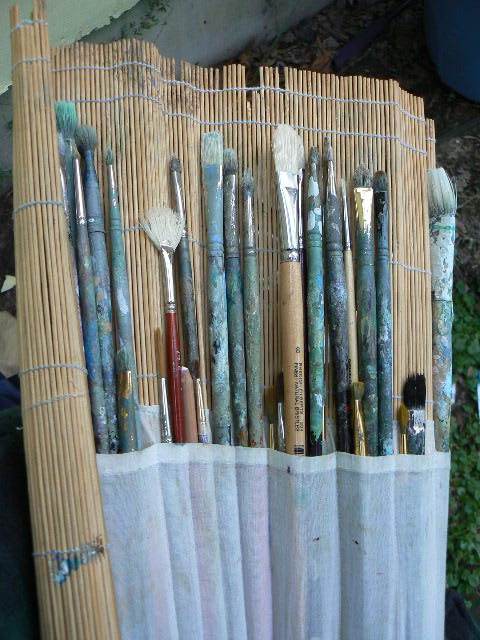
I work off an EASyL Lite paint kit, which includes supplies and panel storage in one single unit. It is made by Artwork Essentials. It makes plein air painting quick to set up. Below, photos of backpack, quick-release tripod, inside backpack, towels, water, brushes, and palette box. This is a thirteen minute video of my work out. Listen for the train whistles.
 
 
My limited palette includes Titanium White, Brilliant Blue, Viridian Hue, Hansa Yellow Pale, Cadmium Red Light, Burnt Sienna, and Alizeran Crimson. This video will give you an idea of my technique. I call it mapping or drawing with paint. I use Utrecht tube paint and brushes. Thirteen minutes. Next, poplar study and me.
 
 
Started  a 16 by 20 cradled panel (above) down by my neighbor's pond which touches our property. I yearn to work more with sky and clouds and minimalize the foreground.
 

Sunday, June 2, 2013

scenery of carrollton, missouri

Ahh.....summer break. Looking to establish my routine as fast as I can. Woodcuts, yes. Drawing, yes. Painting, we'll see. And continued exercise, whether pedalling my bike on blacktop Hwy B or walking laps side to side at the Senior Center or bouncing on my family trampoline, yes, yes, and yes.

So, here is a recent one minute pan of nature just outside of my town, west of Carrollton.
 
Leafy trees, creek bed, sunlit clouds, grave rural road.
It's time to get those pencil studies rolling.

field near Missouri river, graphite on 12 x 9 drawing paper

tree and village hills, graphite on 12 x 9 drawing paper
 

Wednesday, May 29, 2013

students sleuth this


My students studied the picture (BELOW) after our exercises today. It was in the Activate book each received. It was not one of their exercise ideas as. As they spoke their hunches I wrote as fast as I could. Here was their responses.  Double click on image to enlarge


What ?
Tell me what THIS is
 
XA: Looks like lungs.
 
XB: I think it has to do with compression.
 
XC: Looks like wires that connect and overlap and go to somewhere else. It seems like you are doing a Cross Crawl and spinning in circles while doing it.
 
XD: Maybe it is nerves in our body. Cords that attached to your body parts. Circles are pads that cause the part of you to move.  
 
XE: It looks like the circle of the hip starts at the head and ends at the jaw connects to elbow wrist.
 
XF: This is showing you the inside body parts and the nerves. If we didn't have these we would fall on the floor saying: "What do we do?"
 
XF: It is the brain and its abilities. You might not see it on there, but it is there.
 
XG: Looks like lines of snakes for you stretch to get wiggles out.
 
XH: The part a picture of your signals. What you might use in brain gym.
 
XI: These are nerves of what we do in brain gym.
 
XI: In our brain there are little people with files with paper. They tell the knees to curl up in our exercise and send emails to the others of what to do. Just like a math book, we have a book in our brain that we get knowledge from.
 
My prayer was answered this morning. Wonderful thoughts and hunches. Good job class.


Saturday, May 25, 2013

student collage after mine

Follow her lead, students of Ms. Allen painted their cardboard base and let it dry. Then each chose their own materials from an offered pile: playing cards, foil, pipe cleaners, plastic beads, and candy wrappers. Then they glued these down to the cardboard base. Here is what their collage works look like.
 
my original collage which inspired the class

Saturday, May 18, 2013

for my students - book project complete


The past month I have hunkered down to LAY OUT the "year end book" for my students at Field School. It was a tradition I carried out for all three school terms (The Challenge 2004, What's Going On? 2005, and Motion Puzzles 2006) for my OT students at Root and Dietrich and High School and Adams in Carrollton. Because this year was a new school in another city and a fresh start to a familiar subject,  I re-examined WHAT I wanted the compilation TO SAY. My OT (occupational therapy) heroes were all back-- Dr. Paul E. Dennison, Athena Oden (physical therapist) and the neuro-physiologist Carla Hannaford. My waking prayer: breathe on the pages. That breath came, that direction evident. Each step answered. 
Double click on pictures to enlarge.


The dinette table used for cutting and inking woodcuts was cleared for the project. Evenings and weekends were spent sorting through previous drawings, deciding on which would come first, which would follow, which would not be included this time around, and which ideas required novel introduction. The hand lettered illustrations were drawn first on folded legal size bond paper. Finally the pages were taped in sequence with Scotch invisible tape on 8 1/2 by 14 inch sheets, folded in half, SO THAT that both sides could be copied on the office copy machine. The 76 page volume has a card stock cover, front and back, and a plastic loose-leaf spine (also called comb binding, or cerlox binding).

      Example of double sided "section" here.
          
Cerlox binding on spine 

For two days -- after I clocked out of work, I made the xerox copies needed. The routine went like this: a two page spread was xeroxed in twenty copies. The pages were gathered out of the upper tray, jogged on the table to make the stack even, and then set in the lower tray to xerox the backside two page spread, twenty copies. Staying on alert for errors, misprints, and making corrections or re-xeroxing said pages. There were twenty-four sections xeroxed back-to-back. Each of section was hand folded down the middle, which made four pages of content.

The sections were stacked in sequential piles on a large table, double and triple checked that the order was right. Then, you grabbed the last section, stepped to the left, grabbed the next section under that, stepped to the left, grabbed the next section under that, and so forth. My wife and I did this kind of hand-collating back when we were attending the California Lutheran Bible Institute (Anaheim) and worked after school at the bindery (click on video link and scroll down to see what hand collating can look like).


The card stock covers were hole punched TWO at a time for twenty sets. The paper book sections were hole punched FOUR at a time, twenty sets. The manual comb binding device had an arm bar you pulled forward, which spread the plastic comb binding curl apart. The hole punched book was carefully loaded in thirds, so that the fingers of the curl reached through the holes. Once loaded, the arm bar was pushed back, the comb curled and held the spine fast. One book complete. Load the next, and the next, and so forth.

Comb binding on spine
 
Student ideas in book
(video link to Styrofoam tray)
?? WHAT ??
Activate by Mr.M (long version) Six minute video.
Sneak peak. DOUBLE CLICK IMAGES TO ENLARGE


The books were handed out Friday and the students were delighted.

A book review worksheet will be completed in class next week. Our classes break for summer the last week in May. I plan to post some of them.
++++++++++++++++++++++++++++++++++++++++++++++


(Comb binding links courtesy of ABC Office and Wikipedia,http://www.abcoffice.com/office-equipment-news/2011/10/is-cerlox-binding-and-comb-binding-the-same/, http://en.wikipedia.org/wiki/Comb_binding, accessed may 18, 2013. Collate video link, http://www.hse.gov.uk/msd/uld/art/papers.htm, collate diagram courtesy of Tech-ni-fold, 
http://www.technifoldusa.com/bindery-success-blog/bid/75802/Hand-Collating-in-the-Bindery-Hazardous-to-Your-Health, accessed May 18, 2013)

Monday, March 25, 2013

umber over birch panel


It was March snow in mid-Missouri.
Thirteen inches out our back door, as shown by the ruler above. Inside the living room it was warm. Work was progressing.


 Grain of 12 by 12 inch birch wood panel (above)
 

Thin umber wash over birch panel makes cuts easier to see.
Graphite marks made on block. Converting wash splotches in three color study into pencil. Six minutes.
 

 Drawing on block. Two minutes.

Elegant curls.


Cuts begin using Speedball linocut tool. Four minutes.


Convert this to pencil marks, please.


Draw the map. Two minutes.

Living room work bench.